Alarm apps are no longer utilities: the service playbook behind Erly, Alarmy, and Sleep Cycle
Published: 2026-04-24
This article is a structured analysis based on public App Store product signals and third-party industry reports. Any download, revenue, and ranking data should be treated as directional signals rather than precise financial disclosure. The three publishers in this piece can all be searched directly on DevScope.
Why should we revisit the alarm app category now?
Most developers still frame alarm apps as a "system feature patch." But category leaders are no longer competing on timer functionality. Their real unit of competition is behavior outcome.
They build a persistent intervention loop around failed wake-ups: pre-sleep setup, wake-time execution, and post-wake feedback.
The category may look small, but top products have proven a structural truth: when a low-ticket utility entry point is upgraded into an operable behavior service, both retention and revenue quality can step up materially.
Three reproducible playbooks, three different growth paths
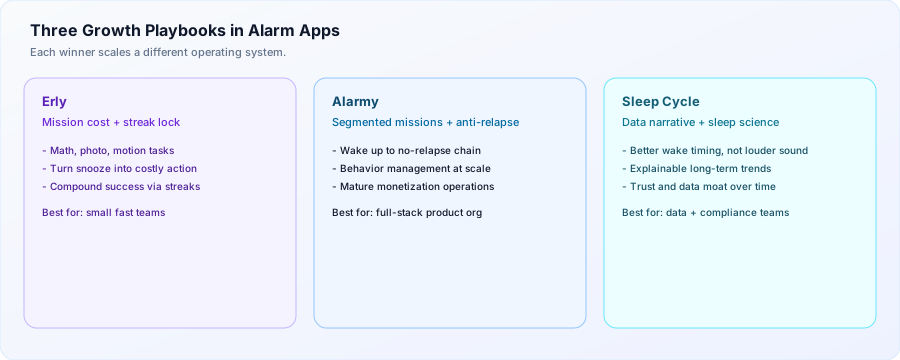
1) Erly: trade mission cost for willpower, then lock behavior with streaks
Erly uses a direct mechanism: math tasks, photo proof, and action verification turn "five more minutes" into a costly decision. The real leverage is streak design. Once users protect a consecutive wake-up record, the product shifts from one-time utility to daily behavior contract.
This model is relatively friendly for small teams: less content-heavy, more mechanism-heavy. Start with on-time wake-up success as the north-star metric, then compound one success into repeated success through streak and review loops.
2) Alarmy: mission segmentation plus relapse prevention as a full behavior system
Alarmy's edge is not mission count. Its edge is the full chain: wake-up, no-relapse, and on-schedule start. Users are not just awakened; they are managed through a complete morning execution path.
This requires a much heavier operating stack: product, strategy, payments, and retention must move together. What can be reused is the logic: segment missions by self-discipline level, stabilize outcomes with anti-relapse mechanisms, and lift ARPU through a "daily performance" narrative.
3) Sleep Cycle: data narrative plus sleep science, slower but stickier
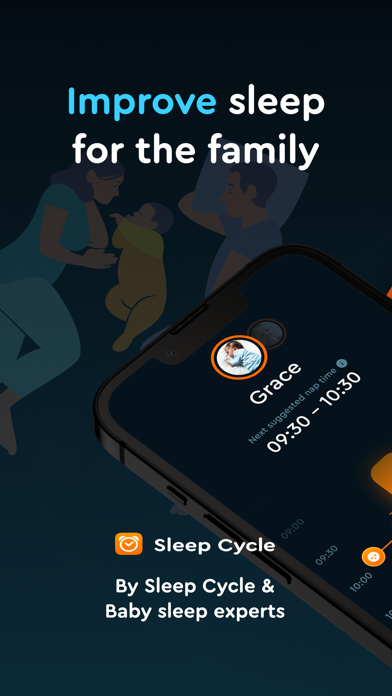
Sleep Cycle does not compete on alarm loudness. It competes on timing quality and explainable sleep trends. Growth is slower, but once validated, willingness to pay for long-term improvement is much stronger than in feature-only products.
Its moat is data, algorithm credibility, and accumulated trust, not interface style.
The key is not DAU. It is the behavior-success funnel.
Many teams get trapped in feature benchmarking and miss the funnel that decides survival:
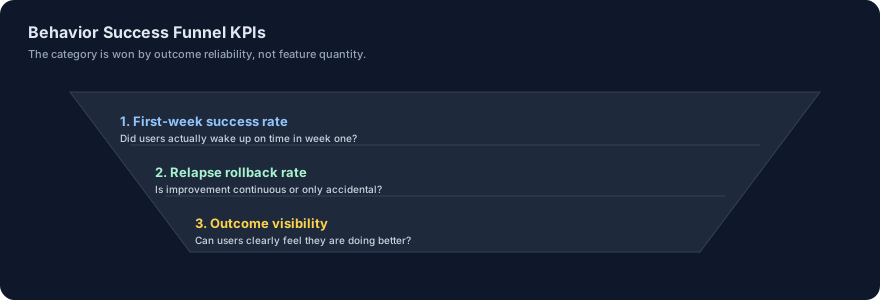
- First-week success rate: did users actually wake up on time in week one?
- Relapse rollback rate: was success consistent or just accidental?
- Outcome visibility: can users clearly feel "my state has improved"?
If these three metrics fail, feature expansion will not beat the default system alarm.
Monetization is not feature unlock. It is fewer failed mornings.
Alarm apps are difficult to scale through a single subscription layer. Mature products usually run a tiered structure: free layer for entry friction, subscription layer for execution reliability, and service layer for long-term value.
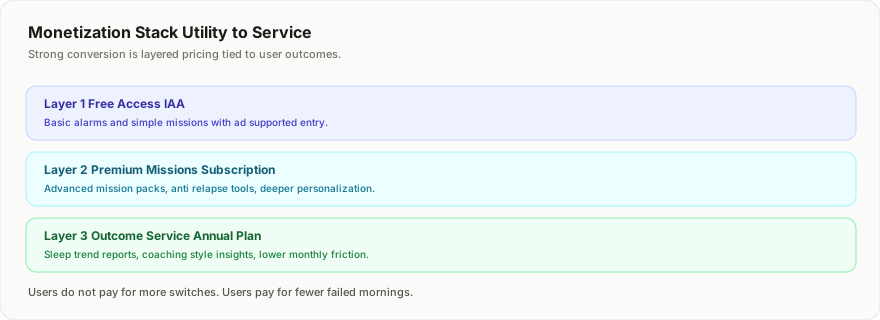
One overlooked point: the first lever for LTV growth is not price increase. It is repeatability of successful mornings. Users renew because they feel better outcomes, not because there are more toggles.
Practical entry paths for indie teams
By team size, there are three realistic tracks:
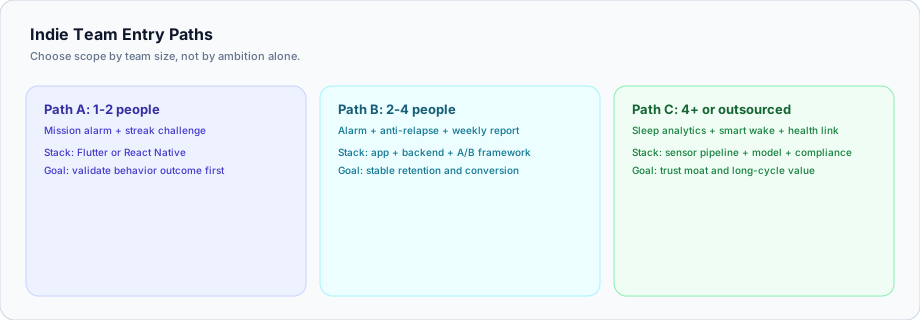
- 1-2 people, lean entry: mission alarm plus streak challenges. Use Flutter/React Native plus local notifications. Validate behavior outcome first, avoid full-stack feature rush.
- 2-4 people, mid-weight entry: alarm plus anti-relapse plus weekly feedback. Pair backend events with A/B frameworks to build stable retention curves.
- 4+ people or specialist outsourcing: sleep analytics, smart wake timing, and health integrations. This path requires long-cycle investment in compliance and algorithm quality.
Differentiation is not copying head products. It is vertical focus: audience verticals (students, shift workers, ADHD users), scenario verticals (jet lag reset, exam sprint, sleep rebuild), or value verticals (privacy-first offline processing, low-interruption mode).
The thesis in three lines: replace user self-discipline fantasy with mechanism design, replace feature inflation with outcome metrics, replace one-time installs with service-cycle thinking.
If you want to inspect public product signals directly, you can open these publishers on DevScope:
If you want to inspect product matrices in detail, search Erly, Alarmy, or Sleep Cycle on DevScope to review rating distribution, release cadence, and subscription signals. Let data guide judgment instead of intuition.
This article will be updated as public signals evolve.
This article is also available in Chinese:
Chinese (简体) →