App Factory Anatomy: Three Playbooks from AIBY, Bending Spoons, and Glority
Published: 2026-04-17
Editorial note: This analysis draws from public App Store data, Sensor Tower public estimates, company LinkedIn profiles, and industry reporting. Revenue figures are third-party estimates and should be treated as directional, not precise. All views represent editorial analysis and do not reflect any official company position.
You think it's luck. It's actually manufacturing capability.
The mobile app industry is full of "accidental hit" stories. But if you trace back the publishers who consistently appear at the top of the charts year after year, a less romantic picture emerges: the teams that make hits repeatedly are not lucky. They have built repeatable systems for making products.
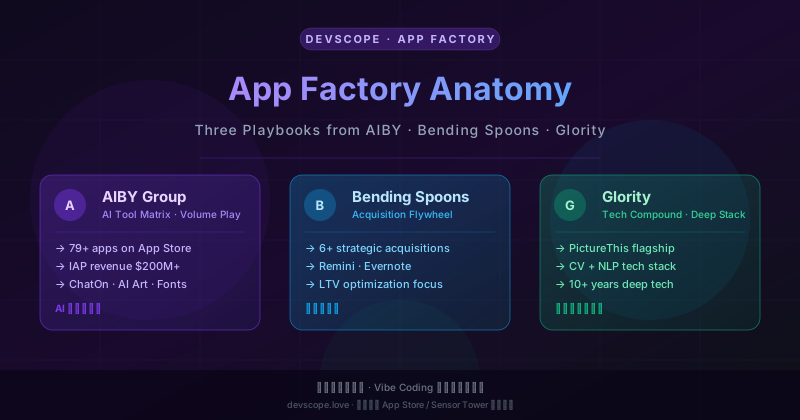
Three companies are worth studying closely: AIBY Group, Bending Spoons, and Glority.
They come from different regions, built on different foundations, and pursued different playbooks. But they converged on the same outcome: the ability to produce commercially successful products at scale, in an industry where most individual apps fail.
This article is not about celebrating these companies. It is about taking their methods apart and asking what is actually relevant to indie developers and Vibe Coding teams who are thinking about what comes next.
AIBY Group: The AI-Tool Factory Textbook
During the 2023–2024 Chatbot wave, opening the Sensor Tower AI app rankings would reveal something striking: a disproportionate share of the top 20 products came from AIBY Group's publishing accounts.
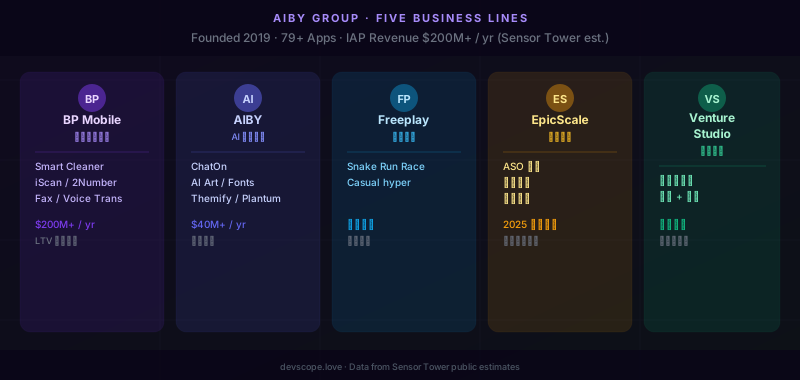
AIBY was founded in 2019, registered in the US, with a core team drawn heavily from Russia and Ukraine. Today it operates five distinct business lines: BP Mobile (productivity tools), Freeplay (casual gaming), AIBY (AI product publishing account), EpicScale (growth and publishing platform), and a Venture Studio (internal incubation).
This structure matters. It is not the logic of an indie developer shipping one product. It is an organized product manufacturing system built at the organizational level.
BP Mobile: The Subscription-Driven Cash Engine
BP Mobile was established in 2010, well before the AI wave, and focuses on efficiency tools: Smart Cleaner, iScan, 2Number, Fax, Voice Translator, and others.
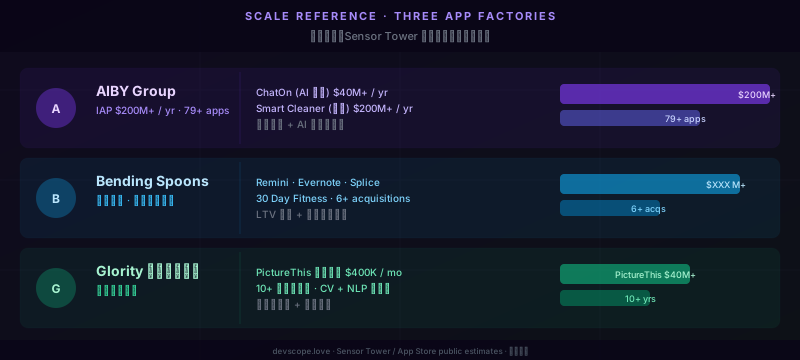
What is worth studying here is not the product category but the monetization design. According to public estimates, BP Mobile's subscription systems have been refined through extensive A/B testing. Paywall structure, trial duration, price tier positioning — there is a clear experimental logic behind each one. Smart Cleaner's monthly revenue is estimated at over $2 million; 2Number at approximately $700K per month.
More importantly, BP Mobile's approach departs sharply from the "heavy paid acquisition, weak retention" pattern common in many tool publishers. The model is subscription monetization paired with user-level retention engineering, meaning LTV is the central anchor for every growth investment.
The AIBY Publishing Account: Stake the Claim, Then Polish It
The AIBY publishing account leans toward entertainment and AI products. ChatOn is the most well-known: an AI chatbot app that reportedly reached daily download peaks of 120,000 during the height of the 2023 AI demand surge.
The strategy behind that number is worth understanding on its own terms: launch fast to claim search and featuring real estate, then iterate hard to outrun the initial crop of competitors. ChatOn's early product quality was modest. The team used A/B testing, broad localization coverage, and a well-resourced paid acquisition operation to push it into a category-leading revenue position.
Beyond Chatbot, the AIBY account operates across UI customization (Fonts, Themify), plant recognition, heart rate monitoring, AI keyboard, and other high-frequency tool categories. The coverage is deliberately wide.
EpicScale: When the Factory Becomes a Service
In May 2025, AIBY announced EpicScale — a publishing platform designed to bring AIBY's growth infrastructure (ASO, creative assets, paid acquisition, store optimization) to external developers.
The translation is straightforward: the internal capabilities that took years to build are now being packaged as services for developers who have strong products but limited marketing infrastructure. For most indie developers, the EpicScale offer — creative asset production at scale, paid channel management, ASO — represents exactly the capability gap that is hardest to close alone.
→ Search for AIBY, BP Mobile, or Codeway on DevScope to explore their full product portfolios and category distribution: Open DevScope
Bending Spoons: Acquisition Flywheel and Cash Flow Compounding
Bending Spoons is an Italian company, founded in Milan by three young Italians who met in Copenhagen. Its products include Remini (AI photo enhancement), Splice (video editing), Evernote (notes), and 30 Day Fitness. What they share in common is that none of them were built from scratch by Bending Spoons.
The Lesson from Failure
Co-founder Luca Ferrari has been explicit about the logic: "We chose this path because we were too arrogant before. We thought we knew what the market wanted. So we changed our approach — let others validate product-market fit. If they're willing to sell, we acquire and then work to make it better."
This is a cold and nearly counter-intuitive approach. Most developers are energized by the zero-to-one creation phase. Bending Spoons deliberately avoids it and focuses all of its operational energy on the one-to-ten scaling phase.

The Seven-Step Flywheel
Bending Spoons' commercial logic, stripped to its simplest structure, runs like this:
- Identify a mature product with an established user base but underoptimized monetization
- Acquire it; rebuild the subscription system to maximize LTV
- Use the higher LTV to justify more aggressive paid acquisition across Google, Facebook, and Apple Search
- New users × stronger monetization = rapid revenue and cash flow expansion
- Deploy the new cash flow plus credit facilities to fund the next acquisition
- Repeat
Each acquisition is typically followed by significant headcount reduction. Cost contraction is how Bending Spoons maintains the high margins that sustain the flywheel. This is also the most debated part of their model.
For indie developers, directly replicating this playbook is not realistic. But it offers an important structural insight: a well-built monetization system is an asset that creates value independently of any single product. Getting subscriptions, LTV engineering, and paywall design right is not just about maximizing returns on today's app. It is about building a reusable operational capability.
Remini as a Signal
Remini is Bending Spoons' most widely recognized product and its clearest AI statement. The app applies deep learning to enhance old, blurry, or low-resolution photographs, and has generated multiple viral waves on social media. Based on public estimates, it ranks among the top AI image apps by both user scale and revenue.
→ Search Bending Spoons on DevScope to view their full product portfolio and App Store public signals: Open DevScope
Glority (睿琪科技): Technology Compound and Deliberate Expansion
If AIBY represents aggressive distribution-first scaling, Glority is closer to a technology-compound case — a team that built depth in a narrow technical area and then expanded outward from that base.
Glority's flagship product is PictureThis, a plant identification app powered by computer vision. The app grew substantially during the COVID-19 period, which led many observers to attribute its success primarily to timing. The underlying story is more interesting.
Where the Technology Came From
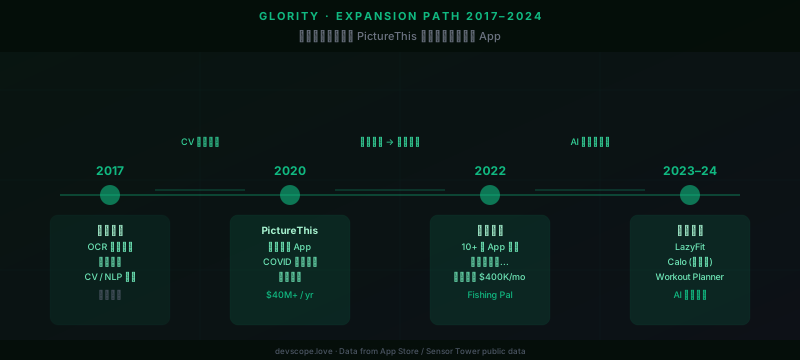
Glority is connected through corporate records to a Hangzhou-based company (大拿科技) that was building photo recognition products as far back as 2017 — a homework-checking app using OCR for elementary school students, along with document scanner and flashcard products. The core investment was in computer vision and natural language understanding, years before plant identification was a visible consumer opportunity.
PictureThis didn't succeed because the team got lucky in 2020. It succeeded because years of technical depth made it possible to build a genuinely differentiated product when the market condition arrived.
From One Plant App to a Recognition Matrix
In 2022, Glority accelerated: ten new recognition apps launched within a single year, covering birds, insects, mushrooms, rocks, crystals, coins, and other natural or physical objects.
The decision came from a clear user signal. The PictureThis team observed users "misusing" the plant app to identify everything else around them — birds, stones, bugs. The underlying need was broader than a single category. That insight, combined with an existing technical stack, made rapid multi-category expansion structurally feasible.
Public estimates suggest three of the ten new apps reached monthly revenues above $100K. The rock identification app reportedly reached $400K per month. These are not random outcomes from volume publishing. They are the result of productizing a technical capability across adjacent demand categories.
From 2023, Glority extended into health — LazyFit, Calo (calorie tracking), and Workout Planner — applying AI-powered visual and analytical capabilities to higher-frequency daily use cases.
The Insight for Technical Developers
Glority's case offers a distinct and underrated reference for indie developers and Vibe Coding teams: deep technical investment in a specific domain creates optionality that is much cheaper to exercise than most people assume. If you have genuine accumulated expertise in a technical area, expanding laterally into adjacent verticals costs a fraction of what it would cost a team starting from scratch.
Vibe Coding has lowered the floor for building. It has not diminished the value of going deep in a specific technical direction. If anything, it makes the gap between developers with real domain depth and those without more pronounced.
→ Search Glority or PictureThis on DevScope to view their product matrix and category-level rating structure: Open DevScope
What Actually Transfers to Indie Developers
After studying these three companies, it is easy to fall into a comparison trap — feeling that you lack AIBY's distribution infrastructure, Bending Spoons' acquisition capital, or Glority's accumulated technical base.
That framing misses the point.
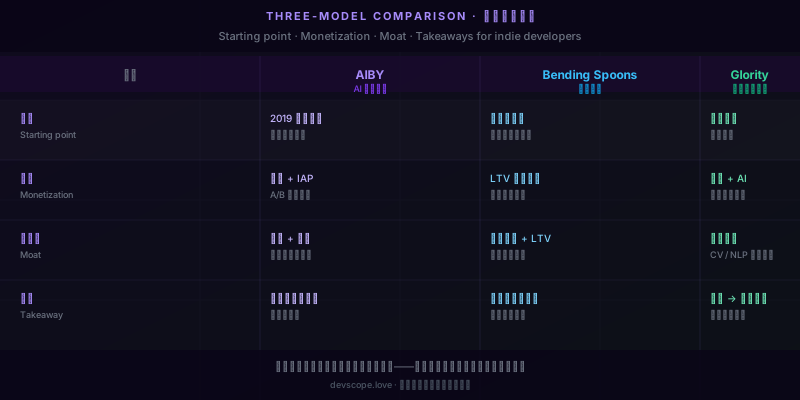
All three companies demonstrated the same underlying principle from different angles: hits are a byproduct of capability, not a primary target. Here is what transfers:
1. Design monetization as part of the product, not as a post-launch addition.
Both AIBY and Bending Spoons make this clear. Paywall design, subscription structure, and A/B testing frameworks should be embedded in product architecture before launch — not layered on afterward.
2. Technical depth compounds in ways that breadth cannot replicate.
Glority's expansion was cheap because their technical foundation already existed. For developers with genuine expertise in a domain, lateral expansion is much more capital-efficient than pursuing unrelated categories.
3. Distribution needs to be actively engineered, not passively hoped for.
AIBY's creative asset scale and TikTok acquisition infrastructure reflect a core belief: good products do not automatically get discovered. Building discoverability into product design from the start is one of the most consistent gaps between app factory operators and typical indie developers.
4. Portfolio scale without directional clarity is not a strategy.
Each of these three companies operated with clear internal logic — AIBY covers AI tools vertically, Glority expands from a technical base, Bending Spoons applies consistent acquisition criteria. Volume is an output of focus, not a substitute for it.
Closing
The core of an app factory is not "having many products." It is "having a mechanism that reliably produces good products."
For today's indie developers and Vibe Coding teams, the value of these three case studies is not a replicable blueprint. It is an analytical framework: in the current cycle of mobile subscriptions, AI tools, and cross-border growth, the teams that win consistently are running on repeatable systems, not inspiration.
If you want to study these publishers' public product footprints directly, DevScope lets you look up each developer account by name, inspect category distribution, rating structure, app timelines, and review volume. That kind of public-data audit will usually show you more clearly what a team is betting on than any analyst summary.
→ Search these publishers on DevScope: devscope.love
Revenue figures cited in this piece are based on public third-party platform estimates and should not be treated as precise or verified. When updatedAt changes, key figures will be reviewed and updated.
This article is also available in Chinese:
Chinese (简体) →