A high-output portfolio in the wild: WhatsGoodApps LLC, product matrices, and lessons for indies
Published: 2026-04-09 · Updated: 2026-04-17
Editorial note: This analysis is based on Apple’s public metadata and the DevScope developer profile as shown at read time. Product names, category distribution, ratings, and review counts cited below come from public App Store listings and are used for developer research and structural analysis, not as unverified claims about revenue, commercial performance, or internal strategy.
Why this developer is worth studying
For indie developers, small studios, and the fast-growing wave of Vibe Coding teams, accounts like WhatsGoodApps LLC matter because they are neither anecdote nor myth. They are publicly inspectable cases of what a long-running, multi-category, high-output publishing strategy looks like in practice.
The real editorial question is not whether the team is “legendary.” It is whether public store evidence can tell us how the portfolio is organized, why the pattern persists, and which parts of the playbook are actually useful to working developers.
WhatsGoodApps LLC (developer ID 598069005) is especially useful as a case because it checks three boxes at once: publicly observable, long-running, and structurally complex.
→ Open the full WhatsGoodApps LLC profile on DevScope
Public data snapshot: is this really a matrix-style publisher?
Start with the store signals that can actually be verified. The visual below reflects the public snapshot at the time of writing; numbers move with storefront region and crawl timing, so the live DevScope page should be treated as the source of truth.
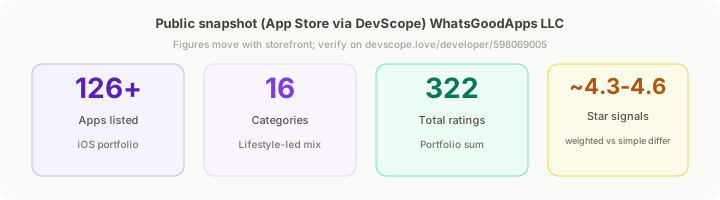
Taken together, the current DevScope aggregate supports a few clear conclusions:
- The portfolio is well past the “side project” threshold: with 100+ iOS apps under one account, this is not casual experimentation. It implies a repeatable publishing engine.
- Category spread points to deliberate multi-lane testing: the account spans 10+ primary categories, with visible weight in Lifestyle and Entertainment and extensions into Travel, Photo & Video, Sports, and more. This is not the signature of a single-vertical studio.
- The rating structure looks like a real matrix: when weighted averages and simple averages diverge, it usually means a small set of head apps are carrying much of the review signal while many long-tail SKUs remain thinly sampled. That is a portfolio effect, not a single-app story.
That distinction matters. Developers should build the fact layer first, then the interpretation layer. Otherwise, “can I copy this?” becomes a premature question.
What kind of product logic is visible here?
Without pretending to know the team’s internal decisions, the public listing still reveals four recognizable lines of execution:
-
Matrix-style publishing under one legal entity
Releasing many SKUs over a long period under one developer name is essentially a way to trade listing count for search coverage, featuring surface area, and experimentation bandwidth. It also reduces dependence on any one app succeeding. -
Attention-seeking products designed to capture conversation
Some public titles lean heavily toward entertainment, emotion, or social buzz. Their edge is not necessarily feature depth; it is their ability to intercept memes, search intent, and shareable curiosity. In a matrix, these titles often become the visibility leaders. -
Utility products that serve stable, comparable demand
Alongside buzz-oriented SKUs, there are product types that look easier to benchmark on conventional axes: keywords, screenshots, use case clarity, and update cadence. This suggests the team is not relying on virality alone. -
Long-lived titles that build time-based public assets
Older apps that remain live over time accumulate reviews, version history, and store credibility. For outside observers, they form a visible maintenance record. In a matrix strategy, that matters.
In short, this does not look like a team betting on a single hero product. It looks like a portfolio built to absorb experiments, capture attention, serve stable utility demand, and preserve long-term public proof of execution.
Editorial view: what did they get right?
If “right” is limited to what public evidence can support, without inventing revenue stories or internal metrics, then at least four things stand out:
- They appear to have built process before chasing singular hits: portfolios of this size only persist when release, upkeep, and iteration are already somewhat systematized.
- They treat discoverability as part of product design: naming, category spread, and the visible review imbalance all suggest that attention is being engineered, not left to chance.
- They are running cross-type experiments inside one operating shell: utility and entertainment products under one account imply that the same shipping muscle is being used to test different user intents and monetization possibilities.
- They leave enough public surface area for meaningful analysis: that is valuable for the rest of the ecosystem, because it lets other developers study portfolio dynamics rather than romanticize isolated wins.
Two sources worth pairing with the App Store listing
For developers doing serious market work, the App Store listing is only the first layer. Two additional sources are usually worth checking: the official website narrative and relative-trend data from intelligence platforms.
Website: a public-facing site such as whatsgoodapps.com usually carries the brand story, positioning, and partnership language. That narrative does not always map neatly to the developer account name. Read the site and the App Store page together.
Sensor Tower, data.ai, and similar tools: useful not because they reveal perfect absolutes, but because they offer relative movement, time trends, and comparative context. For matrix publishers, that distinction is crucial.
The practical workflow is simple:
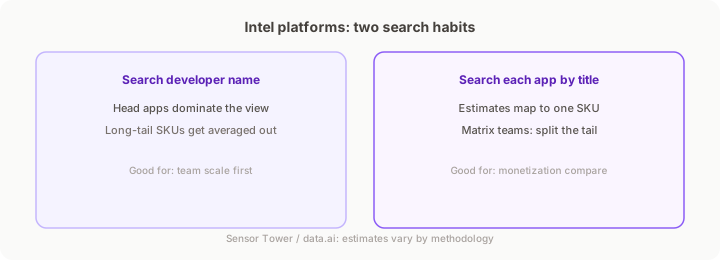
- Look at the developer account first to understand total publishing weight and category spread.
- Then inspect apps one by one to see which titles carry visibility or likely commercial weight.
For portfolio teams, “many apps” and “commercially effective” are not interchangeable claims. They have to be tested separately.
What indie developers should learn from this, and what they should not misread
This is where the case becomes practically useful. Over the last year, Vibe Coding has materially reduced the cost of building interfaces, boilerplate, copy, and localization. That naturally leads more developers to ask: if it is easier to ship one app, should we all be moving toward many-SKU strategies?
The answer is: study it, but do not flatten it into a slogan.
AI can shorten build time. It does not automatically solve demand validation, App Review risk, retention, monetization, or maintenance. Those are still operating problems.

That visual captures the difference: shipping speed and commercial truth are related, but they are not the same thing.
Three lessons that are genuinely worth taking
First, learn the experimentation structure, not the surface outputs.
Many SKUs are useful because they turn product development into a portfolio of experiments rather than a single all-in bet.
Second, study category allocation.
Good matrix operators usually have a main lane and a set of probes. That is more informative than raw app count.
Third, treat discoverability as an early product decision.
Many indie teams wait until launch to think about naming, screenshot framing, search hooks, and click intent. Cases like this suggest that discoverability is being considered much earlier.
What “high output” should not be misunderstood to mean
If the takeaway becomes “AI makes it easy, so just publish more apps,” most developers will learn the wrong lesson. At least three constraints remain unavoidable:
- Compliance and review complexity scale with SKU count. This is especially true in entertainment, dating, health, sweepstakes, and other policy-sensitive spaces.
- Maintenance cost does not disappear because AI wrote part of the first version. Bugs, compatibility, screenshots, review management, metadata updates, and support all compound.
- Public store structure is not the same as revenue proof. DevScope can reveal how a portfolio is shaped, but not whether its economics are strong enough to justify imitation.
If you want to try a matrix, where should you start?
For most indie teams, the sensible path is not to jump straight to dozens of apps. It is to build and test a minimal sub-matrix first.
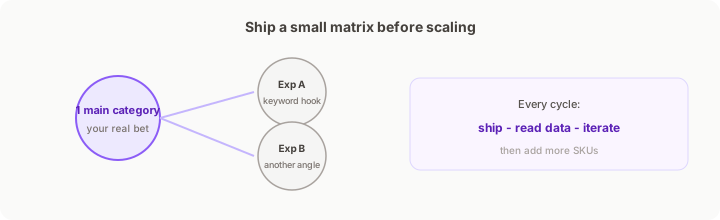
- Choose one primary category you can genuinely support over time.
- Add one or two trial SKUs around different hooks, keywords, or use cases, and run the full loop: ship, observe, revise, compare.
- Scale only after the data clarifies the structure. If head-app effects dominate early, the question is no longer “how many more apps,” but whether to amplify the head or redesign the tail.
For most small teams, getting these three steps right is already far closer to a real portfolio strategy than chasing app count for its own sake.
FAQ
Q: Why can app counts on DevScope differ from third-party sites?
A: Different crawl times, regional storefronts, and whether delisted apps are included—trust what the App Store shows now; DevScope updates with API and cache policy.
Q: May I cite numbers from this article verbatim?
A: Cite the data timestamp and link back to the App Store / DevScope; store data moves.
Closing
WhatsGoodApps LLC matters less as a hero story than as a fully visible structural sample. For today’s indie developers, the point is not to imitate titles one by one. It is to understand how “high output” decomposes into organization, category mix, attention design, head-app effects, and maintenance burden.
If you are evaluating whether a multi-SKU strategy fits your own roadmap, the best next step is still the simplest one: go back to the public profile and inspect the apps, categories, timelines, and rating structure for yourself.
→ DevScope: WhatsGoodApps LLC (598069005)
Store metadata changes; when updatedAt moves, we revise highlights accordingly. For partnerships or licensed data, follow official channels.
This article is also available in Chinese:
Chinese (简体) →