Why Tiimo Won iPhone App of the Year: The ADHD-First Design Playbook (and the Gaps the Community Still Wants Filled)
Published: 2026-07-15
Researched and reviewed by DevScope Editorial Team
A visual planner from a small Copenhagen team just beat the productivity giants: Tiimo won Apple's 2025 iPhone App of the Year, after being a 2024 Apple Design Award finalist in the Inclusivity category. It has passed a million downloads and gets written up by Forbes, Fast Company, and NYT Wirecutter — for an app that does something most task managers refuse to do: it assumes your brain does not work like everyone else's.
That's the whole story, and it's a lesson worth studying. Below is a teardown of why Tiimo works, what the ADHD community actually says about it (pulled from years of Reddit and Medium discussion), and where the still-open gaps are — the kind of demand signals indie builders should be reading.
Research the team behind it: Tiimo's developer portfolio on DevScope — ratings, versions, and the rest of what this studio ships. Or study the visual language directly in the App Store screenshot gallery.
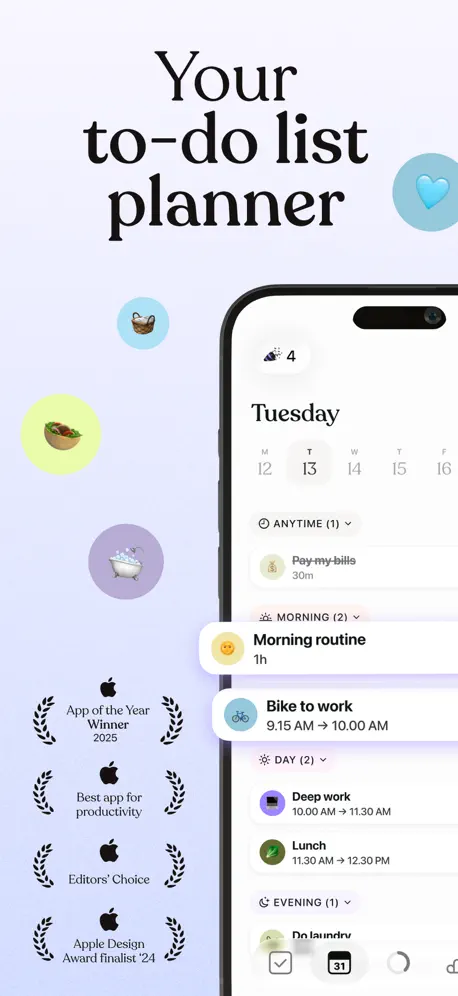 Tiimo turns your day into a visual, color-blocked timeline — shown here beside its Apple App of the Year 2025 and Design Award finalist '24 badges. (Screenshot: Tiimo on the App Store)
The core insight: ADHD brains can't "see" time
Most productivity apps are built on an assumption: that you can hold focus, switch tasks smoothly, and feel time passing. That is precisely what an ADHD or autistic brain often cannot do. "Time blindness" — the inability to sense how long things take or how much time is left — is a defining executive-function challenge, not a lack of willpower.
Tiimo's answer is to make time visible. Your day becomes a color-blocked timeline with emoji markers; a focus timer counts down in front of you; widgets and Live Activities keep the next block on your lock screen so the plan survives the app being closed. Nothing here is a novel feature in isolation — but pointed at a specific neurotype, the combination becomes the product.
 Each task becomes a colored block on the day's timeline, so time you can't feel becomes something you can see. (Screenshot: Tiimo on the App Store)
The ADHD-first design playbook (what builders can learn)
Tiimo is a case study in winning by precision, not breadth. Six patterns stand out:
1. Design for one neurotype, not "everyone." The market is flooded with general to-do apps. Tiimo went the other way — built with ADHD and autism experts, for people who find standard planners intimidating. Narrow focus is why it's recognizable, defensible, and beloved.
2. Make the invisible visible. Time blindness → visual timelines. Anxiety about "what's next" → widgets and Live Activities. The design translates an internal deficit into an external, glanceable cue.
3. AI that decomposes, not generates. Tiimo's AI Co-Planner doesn't write your tasks — it breaks them down into small steps with time estimates. It targets the real ADHD pain point: not knowing what to do, but not being able to start. That's a sharper use of AI than "generate a to-do list."
4. Lower the sensory and cognitive load. Calm, sensory-friendly visuals; few decisions per screen. For neurodivergent users, a cluttered UI isn't just ugly — it's a barrier to entry.
5. Founder–market fit as a moat. Co-founder Melissa Würtz Azari has ADHD and dyslexia. The product reads as authentic because it is — a durable advantage a competitor can't clone by copying features.
6. A freemium line that gates executive function. The free tier plans, lists, and times; Tiimo Pro unlocks AI task breakdown, custom widgets, and advanced scheduling. The paywall sits exactly where the highest-intent, highest-need users are.
 Widgets and Live Activities keep the current focus timer on the lock screen — the plan survives the app being closed. (Screenshot: Tiimo on the App Store)
What the community actually says
Read enough of the ADHD community's discussion of Tiimo — the Reddit threads, the Medium reviews — and the same themes recur. These are demand signals, not just opinions:
 Tiimo's AI Co-Planner takes a messy brain-dump and decomposes it into scheduled steps — targeting the real ADHD pain point: starting. The app cites 45,000+ five-star reviews. (Screenshot: Tiimo on the App Store)
- "Is Pro worth it?" — the single most repeated question. Users love the free app and scrutinize the subscription hard. Lesson: for this audience, value has to be felt, not asserted.
- "Apps similar to Tiimo?" / "Tiimo vs Thruday?" — constant alternative-seeking. A loved app with a subscription generates a long tail of people looking for a cheaper, lighter, or different-shaped equivalent.
- Calendar sync friction — a recurring complaint. Two-way calendar reliability is table stakes people notice when it breaks.
- Platform gaps — "Is there a Windows desktop version?" Cross-platform coverage is uneven, and users feel it.
- Use-case sharing — threads on how people fit Tiimo into routines, body-doubling, and time-blocking. This is the community teaching itself the workflows the app enables.
The buildable gaps (for indie and vibe coders)
Tiimo is a mature, loved incumbent — you don't out-Tiimo Tiimo. But the community's unmet asks are exactly the kind of scoped, buildable directions this site exists to surface:
- A single-workflow, lower-cost companion for one job Tiimo does broadly (e.g., just visual time-blocking, or just task decomposition).
- The reliable calendar-sync layer people keep wishing for — narrow, but real.
- A true Windows/desktop experience for a segment the incumbent under-serves.
- A niche-specific fork — the same time-visibility idea aimed at students, shift workers, or parents managing a neurodivergent kid's routine.
The pattern to copy isn't the feature list — it's the method: pick an underserved neurotype or job, make an invisible struggle visible, and design with the people who live it. Then check the reviews and forums for the gaps the incumbent left open.
Do the research: start from Tiimo's portfolio and public signals, then browse buildable app ideas and the design inspiration gallery to pressure-test your own angle.
DevScope is not affiliated with Tiimo or Apple. This teardown is based on public App Store data, the product's own site, and public community discussion, organized as research — not product, medical, or investment advice.
This article is also available in Chinese:
Chinese (简体) →